
Cue cards for nervous speakers: how to design cards you can trust
Last updated: 18 October 2026 · Written by the Cue Card Converter team at EventProgrammer, event production professionals
When you are nervous, your eyes jump, your place in the text disappears and small print becomes unreadable. Good cue cards cannot remove nerves, but they can make the page easy to find your way back to. This guide covers the layout choices that matter most when you are on stage with a racing pulse, and how to set them up in a few minutes.
Design for the worst moment, not the best
You will probably read your cards calmly in the kitchen. The test is the moment you lose your place in front of a room. Every choice below serves that moment: make the next word easy to find, and make it hard to get the cards wrong.
Large type and few lines
- Big letters: use at least 24 pt for a hand-held card, larger if the lighting is dim. Many speakers need more than they expect once they are standing and the card is at arm's length.
- Space between lines: a line spacing of about 1.5 keeps neighbouring lines from blending.
- Plain font: a clear sans-serif, in sentence case. Capitals only for stage cues.
- Few lines: three to six short lines per card is easier to glance at than a paragraph.
One idea per card
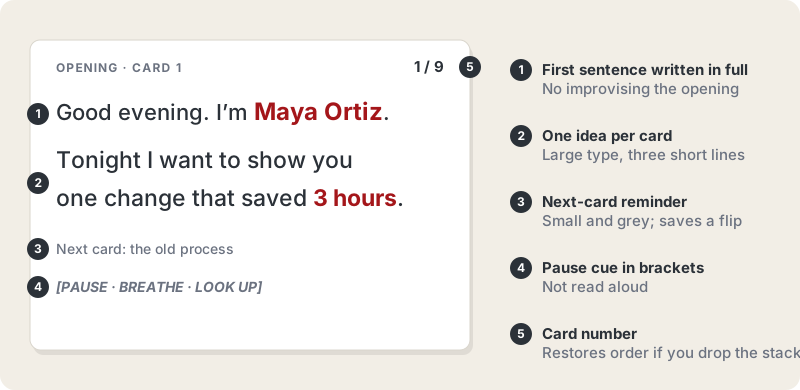
If a card carries one idea, a glance is enough to recover. When a card holds three, you have to find which of the three you were on. Split at natural pauses, and let a short card stay short. If a section is only one sentence, such as a thank-you, put it with the next idea instead of wasting a card. The guide to how many cue cards you need gives rough numbers by speech length.
Number every card
Write the number and the total on each card, for example “4 / 11”, in the same corner every time. If you drop the stack or the order is mixed up before you go on, you can rebuild it in seconds. A numbered stack is the cheapest insurance there is.
Write out the first sentence in full
Opening lines are where many speakers freeze. Write the first sentence of the speech word for word on card one, and the last sentence word for word on the final card. You do not have to read them; the point is that if your mind goes blank, the next words are already in your hand. If you prefer keywords for the middle, keep full sentences at the two ends.
Use colour and marks sparingly
Highlight only what you must get exactly right: names, titles, dates, times and numbers. If everything is highlighted, nothing stands out. Put stage cues in square brackets so you can tell them from lines you speak, for example [PAUSE], [SLOW DOWN] or [LOOK UP]. A pause mark written on the card gives you permission to stop, and a short silence usually feels much longer to you than to the audience.
Holding the cards
- Keep them in one hand, at about chest height, so you can look from the card to the audience without moving your head far.
- Do not hide behind them. Glance down, take a phrase, look up, then speak it.
- Move finished cards to the back instead of dropping them, or slide them to the bottom of the stack.
- Use a tie or ring through a corner hole if you walk around; a rubber band works for a lectern.
- A flat lectern is easier. If you stand at one, set the stack on it and slide the top card aside.
Practise with the real cards
Rehearse at least twice with the printed cards in your hand, standing up, because turning and sliding a card is a physical habit. Time yourself: paste the script into the speech time calculator, or use practice mode in the cue card maker, which steps through the cards with a timer. Practise the pause marks on purpose, since they are the part most speakers skip.
If a long script has to be read exactly, a teleprompter may suit you better; see teleprompter vs cue cards. For printing, the printing guide explains sizes and cut lines.
Set it up in the cue card maker
Paste your script into the cue card maker, pick a card size and raise the font size until a card holds only a few lines. Check the split, make sure the first sentence sits at the top of card one, and print with card numbers on. If you change your mind on the day, edit the text and reprint only the cards that changed.
Frequently asked questions
What font size should cue cards be for a nervous speaker?
Use at least 24 pt for hand-held cards and go larger if the lighting is dim or you read at arm's length. Test by holding the card where you will hold it on stage.
How many words should be on one cue card?
Fewer is easier. Three to six short lines, around one idea, is easy to read at a glance. A longer speech simply uses more numbered cards.
Should I write my whole speech on cue cards?
If you tend to freeze, write the first and last sentences in full and use short phrases in between. If the wording must be exact, as in a toast or an announcement, write it in full and still keep the cards short.
What if I drop my cue cards?
Number every card, for example “4 / 11”. You can then reorder the stack in seconds, even on stage.
Can cue cards stop me from feeling nervous?
No. They cannot change how you feel, but a clear layout makes it easier to find your place when you do. Rehearsing with the real cards helps most.